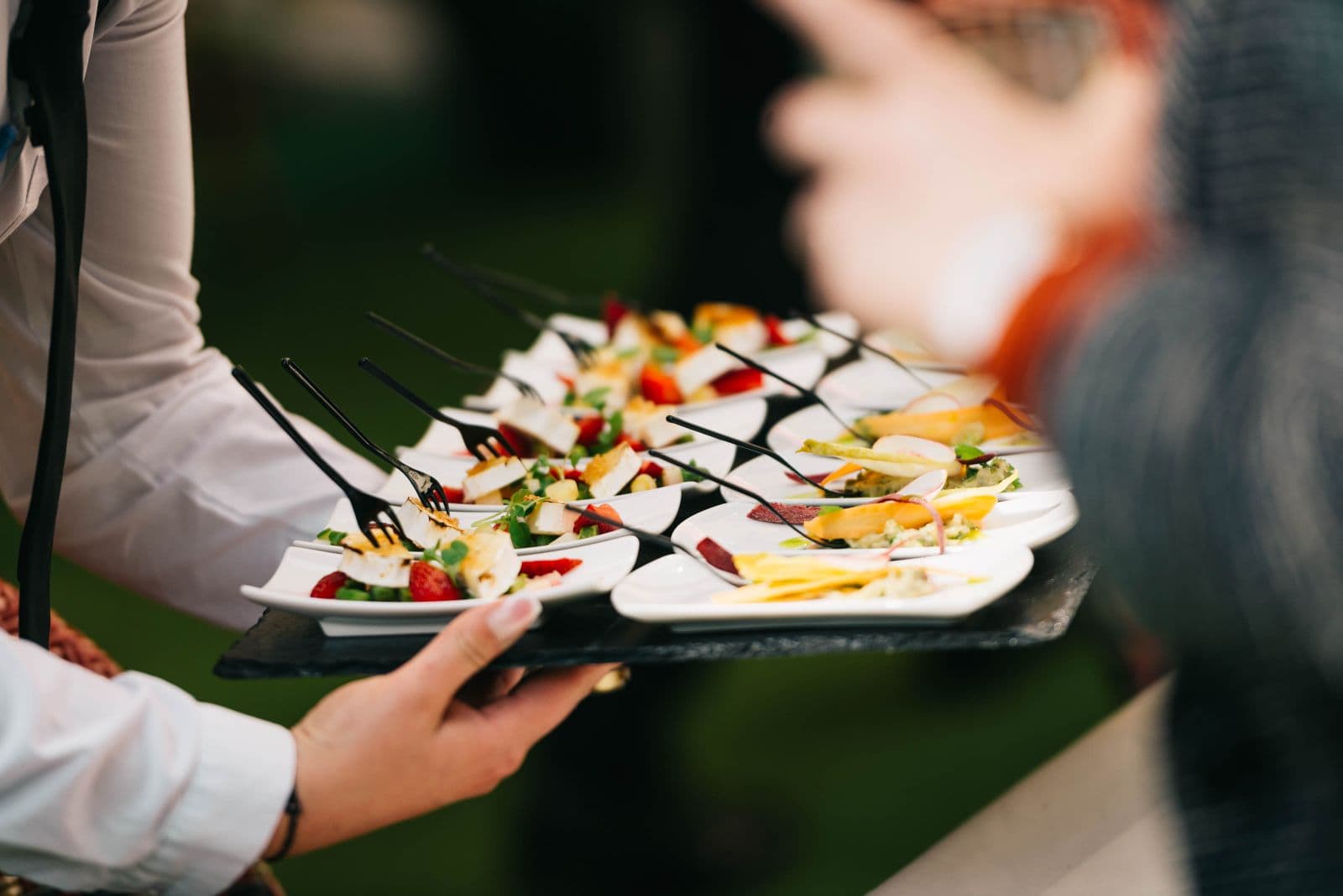
Guests forgive a lot. A late car, a flat speech, rain all afternoon. What they do not forgive is standing about for three hours on an empty stomach while a photographer arranges them into rows. Most wedding food problems are not cooking problems — the cooking is usually fine. They are timing problems, counting problems, and someone-forgot-to-tell-the-kitchen problems. Here is how the food of a UK wedding day actually fits together, and the decisions each part forces on you.
Why it is called a wedding breakfast
The usual explanation is that it is the first meal a couple eat as a married couple — the one that breaks the fast kept before the ceremony, back when fasting before a wedding mass was normal. It has nothing to do with the time of day, which is why your caterer will happily call a sit-down meal at four o'clock a breakfast without blinking. Worth knowing mainly so the word stops confusing you on quotes and running orders.
Canapés matter more than anyone budgets for
The drinks reception is the longest unstructured stretch of the day. The ceremony finishes, people are handed a glass, and then an hour and a half to two hours pass while you are photographed and the room is turned round. In that time your guests drink on an empty stomach, because most of them had a slice of toast at seven and then a two-hour drive.
Canapés are the fix, and they are usually the first thing cut when the quote comes in high. Cut a course from the meal instead. When you compare quotes, ask how many pieces per head each caterer is assuming — three pieces and six pieces are two completely different receptions at similar-looking prices. Ask for at least one substantial thing among the delicate ones: a mini fish and chips, a slider, something with bread in it.
Two practical notes. Ask someone specific to bring a plate and two drinks to wherever you are being photographed, because otherwise you will not see a single canapé. And if your gap will run past two hours — a church miles from the reception, a long list of group shots — you need bowl food or a grazing table, not canapés. Two hours is roughly the point where a reception stops feeling relaxed and starts feeling like queueing.
The meal itself
A three-course sit-down meal with wine service takes about two hours from the moment the last guest sits down. Not ninety minutes. Allow around half an hour a course including serving and clearing, add time for the room to actually sit — calling a hundred people to their seats reliably takes a quarter of an hour — and build the running order backwards from when your evening guests arrive.
The format changes the maths:
- Plated service is fastest and most predictable, and much the easiest for allergies, because every plate goes in front of a named seat.
- Sharing boards feel generous and get tables talking, but they are slower, they need bigger tables than you think, and allergy management is harder when food is being passed around.
- Buffets look cheaper and often are not once you count staff. The real cost is that the last table eats twenty-five minutes after the first. Fix it by having someone call tables up rather than letting the room form one long queue.
- Street food vans and hog roasts are brilliant in a field and awkward in a listed building. Check power, water, waste and where the grease goes.
If you are in a village hall or a marquee, get the caterer to visit before quoting. A domestic kitchen with one oven will shape your menu whether you like it or not.
Speeches before or after
Tradition puts speeches after the meal. The argument for moving them first is entirely about the speakers: anyone dreading it cannot eat, cannot drink and cannot enjoy a word of the meal until it is done.
The argument against is just as real. Speeches first push the food later, guests are hungry, the kitchen has plated food waiting, and speeches always overrun — so the kitchen absorbs the delay. Hungry guests who are drinking make a worse audience than fed ones.
The compromise most caterers can live with is splitting them, one before the starter and the rest between courses, but only if the kitchen is told in writing well in advance and someone keeps time. Whichever you choose:
- Give the kitchen a hard time by which speeches will finish, and mean it.
- Cap the total. Twenty-five minutes across all the speeches is generous. Tell each speaker their limit as a number of minutes, not "keep it short".
- Sort out a microphone. A hundred people and a marquee lining will swallow an unamplified voice, and the quiet nervous speaker is exactly the one nobody will hear.
Dietary requirements: a safety job, not a preference
Treat allergies as a separate task with an owner, not a column in a spreadsheet. Someone at your wedding may have an allergy serious enough to put them in hospital, and the chain from their RSVP to the plate in front of them has several places where it can break.
Collect at RSVP, in a free-text box, with a question that asks for the right thing: do you have any allergies or dietary requirements we should pass to our caterer, and if it is an allergy, how serious is it? A tick list will not surface the unusual ones and it will not tell you the difference between someone avoiding dairy and someone who carries an adrenaline auto-injector. You need both, and you need to know which is which.
Chase the non-responders. Then turn it into a written list — name, table number, requirement, severity — and send it to the caterer at your final numbers deadline. Ask them to confirm it back in writing, and ask what they will actually serve each person, because "we'll do a vegan plate" is not the same as knowing. UK food law requires caterers to be able to tell you about the fourteen declared allergens in what they serve; a good one will ask you sharper questions than you asked them.
On the day, hand that list to your venue coordinator or planner rather than keeping it yourself. You will be busy, photographed and probably a drink or two in. Staff should know which seats, and the server putting the plate down should say out loud what it is and who it is for. Vegan, halal, kosher and coeliac catering often needs lead time and sometimes a different supplier, so ask early rather than three weeks out.
Children and suppliers
Children eat earlier than adults and will not last a two-hour meal. Ask the caterer to serve them first, as the adults are sitting down — food arriving twenty minutes ahead makes an enormous difference to the noise level during speeches. Older children usually want a smaller version of the adult food rather than a nugget. Agree the age bands and the price for each in writing, because "children's rate" means different things to different caterers. Ask the venue how many high chairs they own, not whether they have any.
Then your suppliers. Photographer, videographer, band, DJ, planner, toastmaster: check the contracts, because most specify a hot meal after a certain number of hours on site. Feed them while you are eating and never during speeches, which is exactly when your photographer needs to be working. Most caterers offer a supplier rate for a simpler plate. Count them in your numbers and seat them where they can eat quickly and get back up.
Drinks, and the corkage question
Arrival drink, something with the meal, something for the toast. You do not need champagne to toast with; people will happily raise whatever is already in front of them, and a decent English sparkling does the job. Ask what your caterer plans per head for the meal so you are comparing quotes on the same assumption.
Corkage is where the money hides. If the venue lets you supply your own, get these in writing before you buy a case of anything:
- The charge per bottle, and whether sparkling is charged differently.
- Whether it applies to bottles opened or bottles brought in.
- Whether unopened bottles come back to you.
- Who chills, stores and serves it, and whether that is included.
- Whether there is a cap on how much you can bring.
Then do the arithmetic. Your bottle price plus corkage has to beat the venue's list price by enough to be worth the boot space and the faff. Sometimes it does not.
Dry-hire venues, village halls and marquees flip the problem. You buy everything, but you also need glassware, ice, chilling, bar staff and somewhere for the empties. If alcohol is being sold and the venue is not licensed, someone needs a Temporary Event Notice from the local council, applied for in advance. Giving drink away free is a different matter, but check the venue's own rules rather than assuming. Finally, find out when last orders actually is — usually well before the venue closes — and tell your guests, along with the taxi number.
Evening food, and when it should land
Evening food is not a second dinner. Its job is to soak up drink and give people a reason to pause, and it should land after the dancing has started rather than in the middle of it — commonly a couple of hours or so after the meal ends. Put it in a different room from the dance floor if you can, because a hog roast in the corner of the barn will empty the floor and it will not fill again quickly.
You do not need a full portion for everyone in the building; plenty of people who ate at four will not eat again. But under-catering is the more visible failure, and cold bacon rolls at midnight are nobody's favourite. Tell your caterer how many evening-only guests are coming, and agree in advance what happens to leftovers, because some venues will not let you take food away.
The short version
- Build the timeline backwards from when the evening guests arrive.
- Feed people properly during the drinks reception.
- Allow two hours for three courses, and settle speeches early so the kitchen can plan.
- Collect dietaries at RSVP with severity, and hand the caterer a written list with names and table numbers.
- Feed the children first and your suppliers at the same time as you.
- Get corkage terms in writing before buying a single bottle.
Most of this is admin rather than taste, which is why it slips. Keep the dietary list, the final numbers and the running order in one place your caterer, venue and planner can all see — that is the sort of thing PlanHitch is built to hold — and give one named person the job of carrying it on the day.