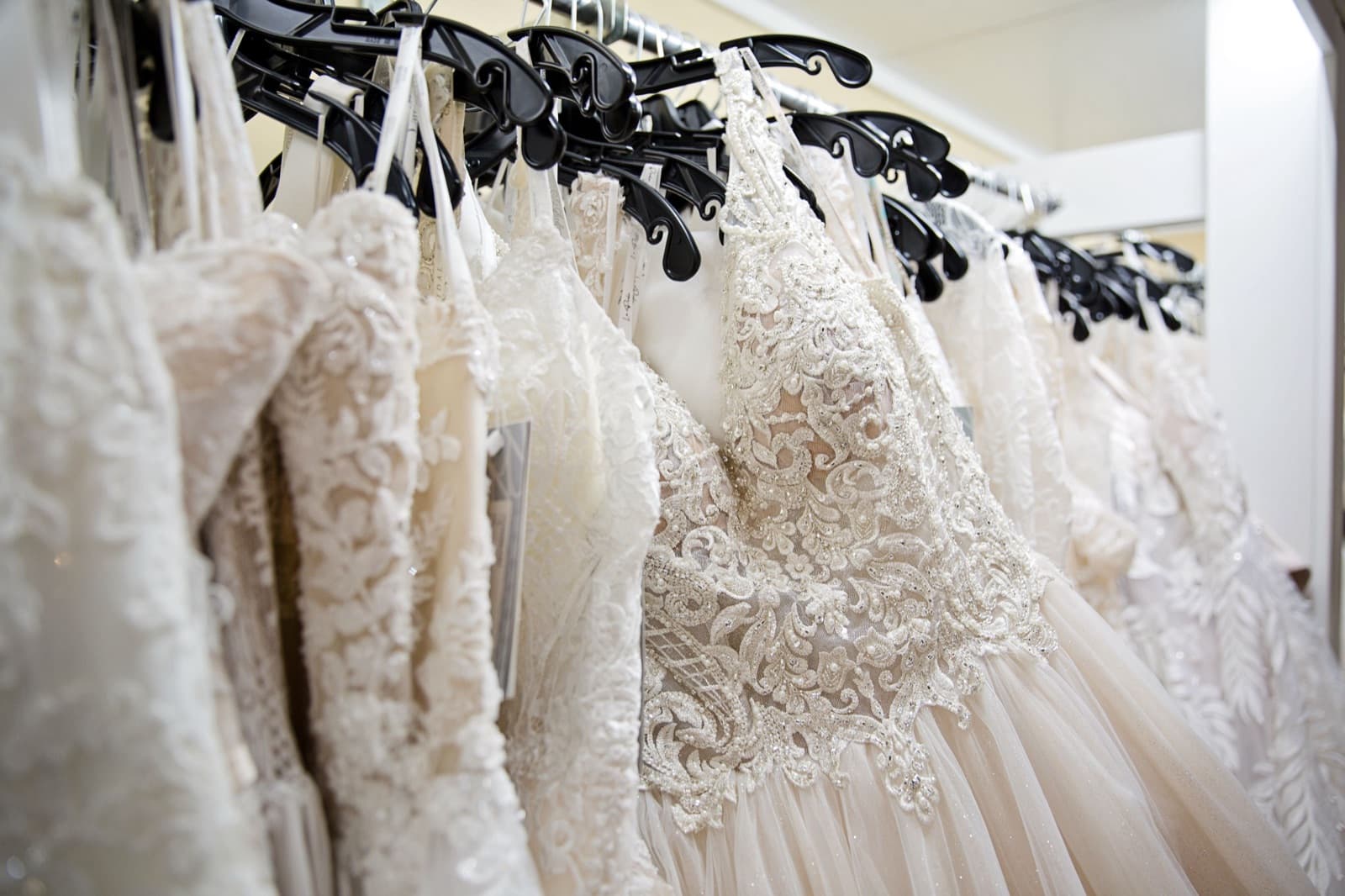
The part of dress shopping everybody pictures is choosing. The part that governs everything is the calendar, and it runs on a timescale that surprises almost everyone.
A dress ordered from a designer is usually made after you order it. That takes months. Then it needs altering, which takes more months, across several appointments. The choosing is the quick bit.
The rough shape of the schedule
Work backwards from the wedding:
- Ordering: commonly around six to nine months before, because production and shipping take most of that. Some designers are faster, some considerably slower.
- Alterations: typically starting two to three months out, over two or three fittings spaced a few weeks apart.
- Final fitting: a couple of weeks before, not the week of. You want room for one more adjustment.
Which means shopping meaningfully starts around nine to twelve months out. Earlier than that and you may be choosing before you know your venue or season, which is a real risk — a dress chosen for an imagined summer garden is an awkward fit for the barn you actually booked.
If you are inside that window, say so at your first appointment. Rush orders exist, off-the-peg exists, and sample sales exist. All are real options, and none of them work if the shop finds out at the end that your wedding is in fourteen weeks.
What actually happens at an appointment
You will try on a handful of dresses, usually in sample size, held together at the back with clips. It will not fit, and it is not supposed to. Learning to see past that is most of the skill.
Some things worth knowing before you go:
- Bring the right underwear and shoes of roughly the right height. Or ask what they have. Hem length is meaningless without them.
- Take fewer people than you think. Two, maybe three. Every additional opinion in the room makes the decision harder and the day longer, and the person whose opinion matters least is usually the loudest.
- Photographs, if the shop allows. Many do not, and that is their right — designs get copied. Ask rather than assume.
- Watch your own reaction, not the room's. The useful signal is not whether people say nice things. It is whether you keep looking.
The costs that are not in the ticket price
The dress price is rarely the dress cost. Budget for:
- Alterations. Frequently a few hundred pounds, and more for significant restructuring or heavily beaded fabric, which has to be unpicked and reapplied by hand.
- A bustle. Anything with a train needs a way to lift it for the evening. It is fiddly, it is charged for, and somebody needs teaching how to do it — bring that person to the final fitting.
- Underwear and accessories. The right foundation garments are not optional with a fitted dress.
- Cleaning and storage, afterwards, if you want to keep it.
Questions to ask before you commit
- What is the expected delivery date, and what happens if the designer is late?
- Are alterations done in house, and are they quoted or estimated?
- How many fittings are included before extra charges begin?
- What is the deposit, and is any of it refundable?
- If this is a sample, what is its condition and can it be cleaned?
That last one matters at sample sales, where the price is excellent and the dress has been tried on two hundred times. Much of the wear cleans out. Some of it does not. Look at the hem and under the arms in daylight before you decide.
A word on sizing
Bridal sizing is its own system and it does not match high street sizing. You will very likely be given a number that is larger than the one you are used to. It means nothing at all — it is a manufacturing convention — and a good shop will say so before it comes up.
Dresses are ordered to your largest measurement and taken in. That is normal, not a mistake. Do not order a size down in the hope of motivating yourself: fabric can be taken in a long way and let out very little, and a dress that cannot be let out is a dress that cannot be worn.
The final fitting
Bring the shoes you will wear, the underwear you will wear, and the person who will help you dress. Practise the bustle until they can do it without instructions. Walk in it. Sit down in it. Sit down at a table, because sitting at a table in a fitted dress is a different manoeuvre from sitting on a chair, and it is better to discover that in a fitting room.
Then take it home and hang it somewhere it will not be knocked, ideally not on the back of a door. It has been six months getting to you. It only has to survive one more week.