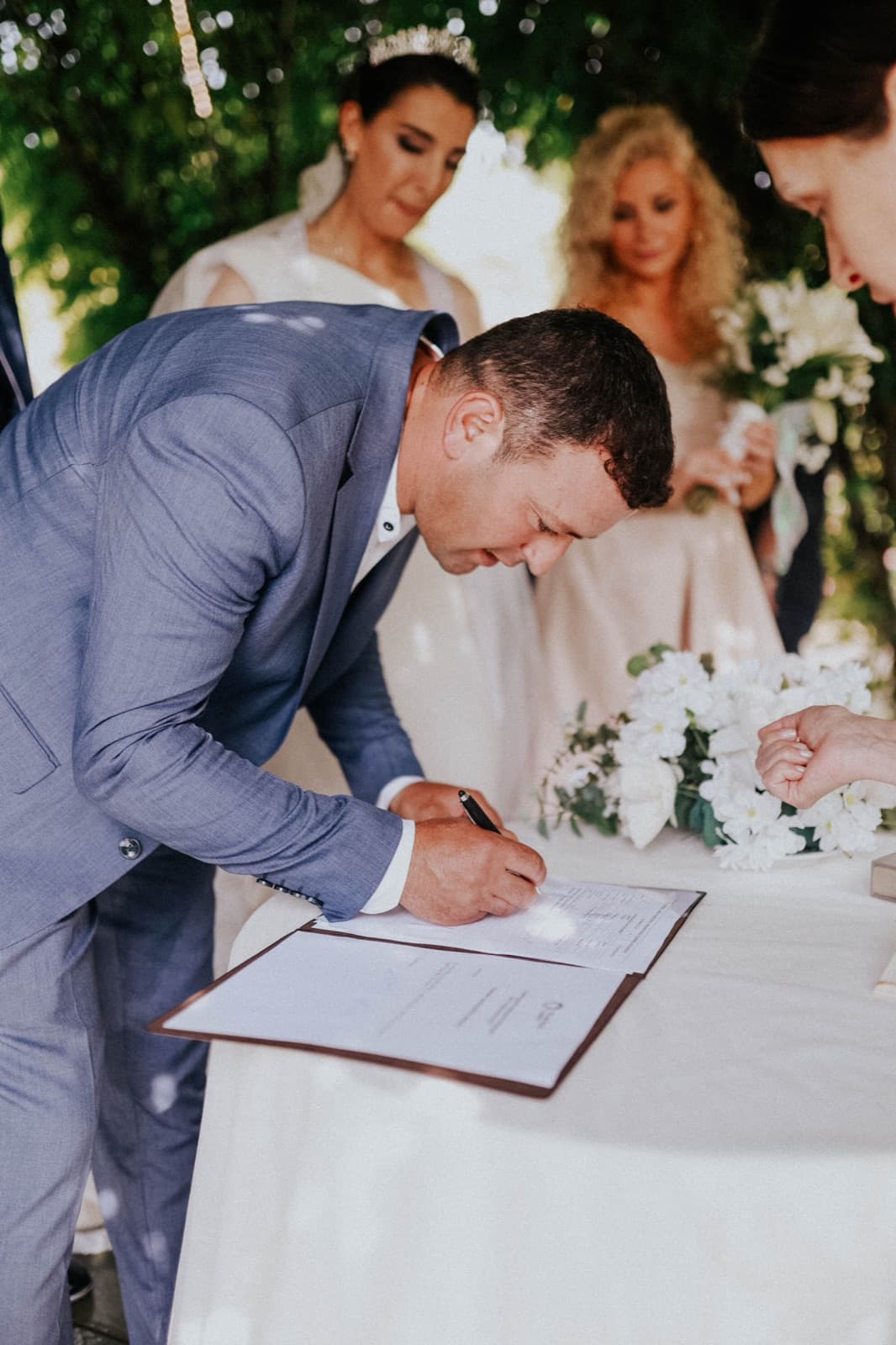
Almost everything about planning a wedding is negotiable. You can change the flowers in April, swap the band in June, and move the whole thing outdoors on the morning if the sun turns up. The legal side is the exception. It has real deadlines, it is administered by people who did not choose your date, and it is the one part where being late does not cost you money — it costs you the wedding.
It is also, in fairness, not difficult. It is just unfamiliar, and almost nobody explains it in the right order.
Two separate things that people merge into one
There is the ceremony, which is the bit with the guests and the readings and someone crying in the second row. And there is the legal marriage, which is a piece of administration that can happen inside that ceremony or entirely separately from it.
Most couples assume these are automatically the same event. Often they are. But separating them is a completely legitimate option, and for some weddings it is the one that unlocks everything else — an unlicensed barn, a beach, a family garden, a venue abroad. If the place you love cannot host the legal part, you can do the legal part quietly at a register office and hold the ceremony you actually want wherever you like.
Knowing that early changes which venues are on your list. Finding it out late means either dropping the venue or dropping the plan.
Giving notice is a legal declaration, not a form
Before you can marry, you both have to give notice at your local register office — a formal statement of intent to marry, made in person, with documents proving who you are and that you are free to marry.
Several things about this catch people out:
- You give notice where you live, not where you marry. If you live in different districts you each give notice separately, in your own. The wedding itself can be somewhere else entirely.
- It has a minimum waiting period. Notice sits publicly for a set number of days before authority to marry is issued. You cannot compress it because your date is close.
- It also expires. Notice is valid for a limited window, so giving it two years out does not work either.
- Appointments are the bottleneck. Not the waiting period — the queue to be seen. Popular offices book weeks ahead, and that queue is invisible until you try to join it.
The current waiting period, validity window and fees are set nationally and do change, and they differ between England and Wales, Scotland and Northern Ireland. Do not take a figure from a blog — this one included. Ring your register office, or check your council's page, and write the real dates in your plan. It is a ten-minute job that removes the single most avoidable way to lose a wedding date.
If either of you is not a British or Irish citizen
The notice process is longer, the document list is longer, and both of you may need to attend together at a designated office. It is entirely routine and thousands of couples do it every year, but it is not the same timeline, and it is not something to discover eight weeks out. Start it first, and build the rest of the plan around what it gives you.
The venue's licence decides your options
A venue can only host a legal civil ceremony if it holds an approved premises licence. Not "it looks like a wedding venue". Not "they've had weddings here". A licence, which covers specific rooms.
Ask three questions, and ask them before you fall in love with the place:
- Are you licensed for civil ceremonies? If the answer involves the word "usually", it is a no until you see it in writing.
- Which rooms are covered? Licences attach to specific spaces. The lawn may not be one of them. Neither may the room you were shown.
- What happens if it rains? If the outdoor spot is licensed but the wet-weather room is not, you do not have a wet-weather plan. You have a hope.
Religious ceremonies work differently again, and the rules vary by denomination. Whoever is conducting yours will tell you what they need — ask them early, in the same week you ask the venue.
The registrar is a separate booking
This is the one that catches the most people. Booking a licensed venue does not book a registrar. They are two different organisations, and the venue cannot hold the registrar for you.
Registrars are a finite resource. On a Saturday in July, in a popular district, they run out. Couples routinely book a venue, celebrate, then discover months later that nobody is available to marry them at two o'clock on that day.
So: provisionally hold the venue, ring the register office the same week, confirm they can cover your date and time, and only then sign anything. If your date is a Saturday between May and September, treat that call as urgent rather than administrative.
Names, and what changes
Nothing about marriage automatically changes your name. If either of you wants to, the marriage certificate is the document that enables it, and then it is a long unglamorous list of organisations to notify — passport, driving licence, bank, employer, GP, insurers, and the loyalty schemes you forgot you had.
Two practical notes. Order more than one copy of the certificate on the day; several organisations want to see an original and some are slow to return it. And if you are travelling on honeymoon soon after, book the tickets in the name on the passport you are actually travelling with, because a mismatch at check-in is not a story you want on day one.
The order to do all this in
- Decide whether the ceremony and the legal marriage are one event or two. Everything else follows from this.
- If either of you needs a longer notice route, start there.
- Shortlist venues, and check licensing before you get attached.
- Provisionally hold the venue and date.
- Confirm registrar availability for that exact date and time.
- Sign, pay the deposit, and note in your plan the earliest date you may give notice.
- Give notice the moment that window opens, and file the paperwork somewhere you will find it.
None of this is the fun part. But it is the only part of the day with a legal deadline, and the only part where doing it in the wrong order can cost you the date rather than the deposit. Get it done early and the rest of the planning is just choices.
Rules and fees differ across the UK and change from time to time. Treat this as the shape of the process, and confirm the specifics with your own register office.