Wedding music is not one decision. It is five, and they pull in different directions. The thing that fills a dance floor at eleven is exactly the wrong thing at two in the afternoon. Work through the day in parts, decide what each part is actually for, and the budget question mostly answers itself.
The ceremony, and what you may not be allowed to play
This is the one place where your taste is not the only consideration. If you are having a civil ceremony in England or Wales — a register office or approved premises — the ceremony cannot contain religious content, and that includes the music. Hymns are out, and so is anything with religious lyrics. Registrars generally ask to see your choices in advance and they do check. Instrumental arrangements of religious pieces are sometimes accepted, but that is a decision for your registration service, not for you and not for a wedding blog.
Churches work the other way round. The incumbent decides what may be played in the building, and plenty will not allow secular pop, recorded music or applause. There may be fees for the organist, the choir and the bells, and there may be a firm view on whether your song is suitable at all. Independent celebrants have no such restrictions, but in England and Wales the ceremony they lead is not legally binding, so the legal part happens separately. Scotland runs differently again, where celebrant-led marriages can be the legal ceremony.
So ask, in writing, before you fall in love with a song. One email to your registrar, vicar or venue coordinator listing what you want saves an awkward conversation a fortnight out.
You need more music than you expect: something for twenty minutes of guests arriving, one piece for the entrance, two or three for the signing of the register — signing plus photographs takes far longer than anyone plans for — and one for walking back out. If it is recorded, decide who presses play, and it must not be a mate's personal phone with notifications switched on. Download the tracks for offline playback, put the device in aeroplane mode, charge it, bring your own cable and adaptor, and test it through the actual system in the actual room. If it is live musicians, ask where they will sit, whether they need power, and what happens if it rains.
Drinks reception and the meal
The reception wants music that fills the gaps in conversation without competing with them. An acoustic duo, a solo guitarist, a string trio, a jazz trio, steel pans if it suits the day — or a playlist through a decent speaker, which is a perfectly respectable choice and the one place nobody will notice you saved money. Outdoors, sound disappears into the open air far faster than people expect, so ask musicians what they need: mains power or a battery PA, shade for instruments, and a wet-weather position that is not "we'll see on the day".
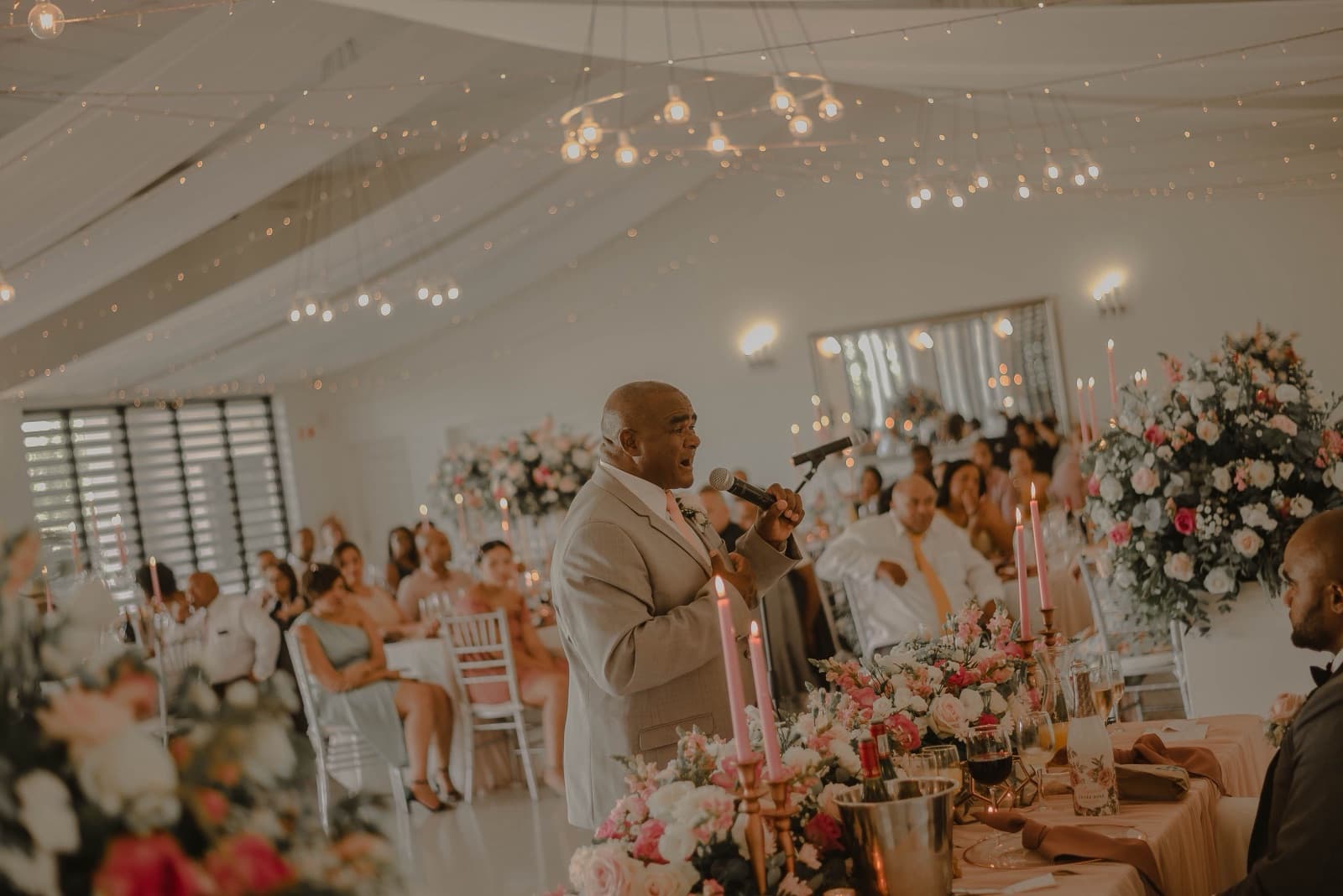
During the meal a playlist is genuinely fine. Make it long enough not to loop, keep it low and even, and avoid anything with a chorus a table will start singing during the starters. Use downloaded tracks on a paid account so an advert does not arrive between courses. The important part is not the songs — it is that whoever runs it can mute it instantly and completely for the speeches, and bring it back afterwards.
Band, DJ or playlist, honestly
A band gives you an event. People watch, people film it, the room gets a focal point. You are paying for the number of people on stage, their travel, their sound engineer, their PA and lights, and their get-in time, which is why quotes vary so much and why a five-piece costs considerably more than a three-piece playing the same songs. Ask what is included: how many sets, how long, what covers the changeover between them, whether lighting is included, and how late they can play.
A DJ costs less, and the good ones are worth far more than the price gap suggests. You are not paying for a music library, you are paying for someone who can look at a half-empty floor at half past ten and know what to do about it. That judgement is the whole product. Ask how they handle requests, whether they will work to a do-not-play list, and what their kit actually looks like — a lot of the general dissatisfaction with wedding DJs is really dissatisfaction with a plastic gantry and a laser.
A playlist is cheapest and it can absolutely work, but only if two things are true: you hire a proper PA rather than relying on a Bluetooth speaker, and one named person owns it all night. It fails when nobody is watching the laptop, when the battery dies, and when the room needs reading and there is nobody to read it.
Whatever you choose, settle the physical facts early:
- Space. Ask the band for their stage footprint in metres and put it on the room plan. The dance floor comes out of the same room.
- Height and access. Barns have beams. Some rooms are up a staircase. Ask about the get-in, parking, and whether there is anywhere for the band to change and wait.
- Power. Bands and DJs want their own sockets, ideally on separate circuits. Marquees and village halls trip. Get the band's power requirements in writing and give them to the venue or the generator supplier rather than hoping.
Noise limiters catch out more couples than anything else
A noise limiter is a device fitted at the venue that monitors sound level and, when it is exceeded, cuts the power to the stage sockets. Many are traffic-light units on the wall. They exist because the venue's licence or planning permission requires them, usually to protect neighbours, and the venue cannot simply switch it off as a favour.
The problem is that a limiter set low can be triggered by an acoustic drum kit or a brass instrument on its own — at which point turning the PA down does nothing at all. When it trips, the power goes off mid-song, and getting everything back on and re-patched takes minutes rather than seconds. Do that twice and there is a hole in your evening.
Ask the venue these in writing before you book a band, not after:
- Is there a limiter, and what level is it set to?
- Where is the sensor, and where is the level measured?
- Does it cut the power, or only warn?
- What time must amplified music stop, and does that apply outdoors too?
Then send the answers to the band before you pay a deposit. Reputable bands will tell you straight whether they can work at that level, and many will offer an electronic kit or a smaller lineup that behaves better. Check the curfew against the bar while you are at it — music stopping at midnight with last orders at half eleven is a very different night from both ending at eleven.
The do-not-play list
Have one, and keep it short. A list of forty songs gets skimmed and ignored; a list of six gets followed. Put on it the genuinely non-negotiable things — the song that belongs to an ex, the one played at a funeral, the novelty record you cannot bear — and let the rest go.
The more useful document is the other one: ten or fifteen songs you definitely want, plus a couple of lines about the crowd. "Lots of guests in their sixties, a big group of Irish family, nobody under twenty" tells a DJ more than a spreadsheet does. Do not hand over a fixed running order for the whole night, because you are paying for judgement and a fixed list removes the one thing a DJ is for. Decide in advance whether guests may request things, and tell the DJ your answer so they are not caught between you and your uncle.
The first dance, and getting people onto the floor
Do it early. Once the evening guests have arrived and had a drink is about right, before the evening food, not at ten when half the room has drifted outside. The first dance is the starting gun for the evening; fire it late and you lose an hour of dancing you have already paid for.
Two things make it painless. First, send the exact version to the band or DJ — album, radio edit, live, the one from the film — because there are four versions of everything and the wrong one is a long three minutes. If the track runs much past three and a half minutes, ask for it to be cut, or ask for everyone else to be brought on after the first chorus. Second, brief specific people to join you: name the bridesmaids, the best man, your parents, and tell them explicitly. Left to volunteer, nobody moves.
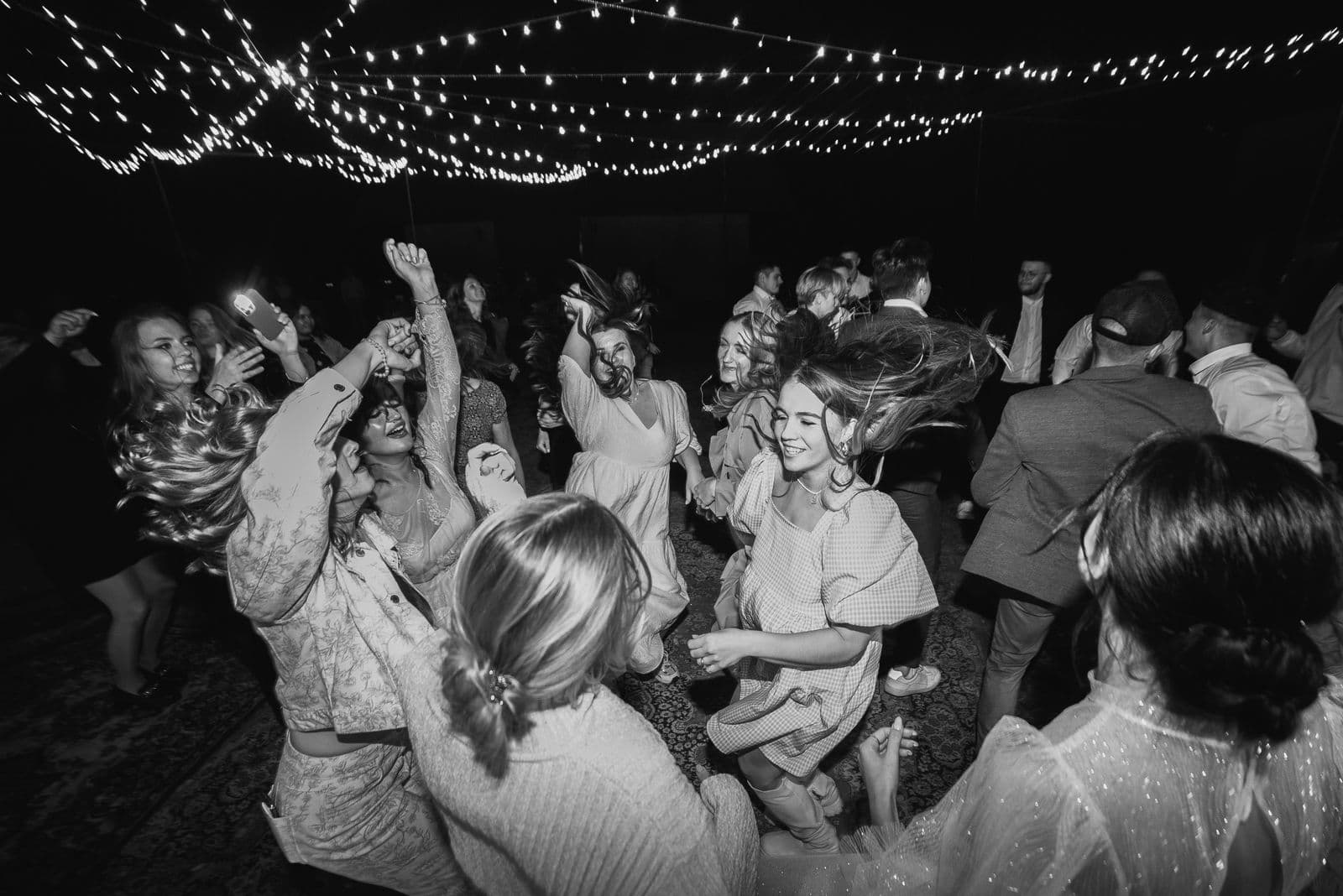
After that, a full dance floor is a room-design problem as much as a music one. Dim the lights. Do not strand a small dance floor in the middle of a huge empty barn — close the room down with your layout so it feels full. Keep the bar near enough that people do not have to leave to get a drink. Play the good stuff early, because people go home earlier than you think, and resist a long slow section in the middle of the evening.
If your guest list runs from eight to eighty, consider a ceilidh. A caller tells everyone what to do, which removes the confidence problem entirely and gets people dancing who would never otherwise. It needs a proper floor and real space, it wants a decent block of time rather than twenty minutes, and you should check whether the band plays a disco set afterwards — otherwise book a DJ for the end of the night.
The bits that get forgotten
- Venues often ask suppliers for public liability insurance and PAT certificates. Request them from your band and DJ early.
- Bands and DJs usually need feeding. Check the contract and tell your caterer.
- Cut the cake before the band starts, while the photographer is still there.
- Write down who has the aux lead, the laptop and the phone numbers, and put it on the running order.
None of this is about taste. Settle the restrictions, the power and the timings early and the taste part — the songs you actually want — stops being a source of anxiety. Keeping the running order, supplier contacts and the do-not-play list somewhere everyone involved can see them, whether that is PlanHitch or a shared document, is the difference between a plan and a pile of emails.