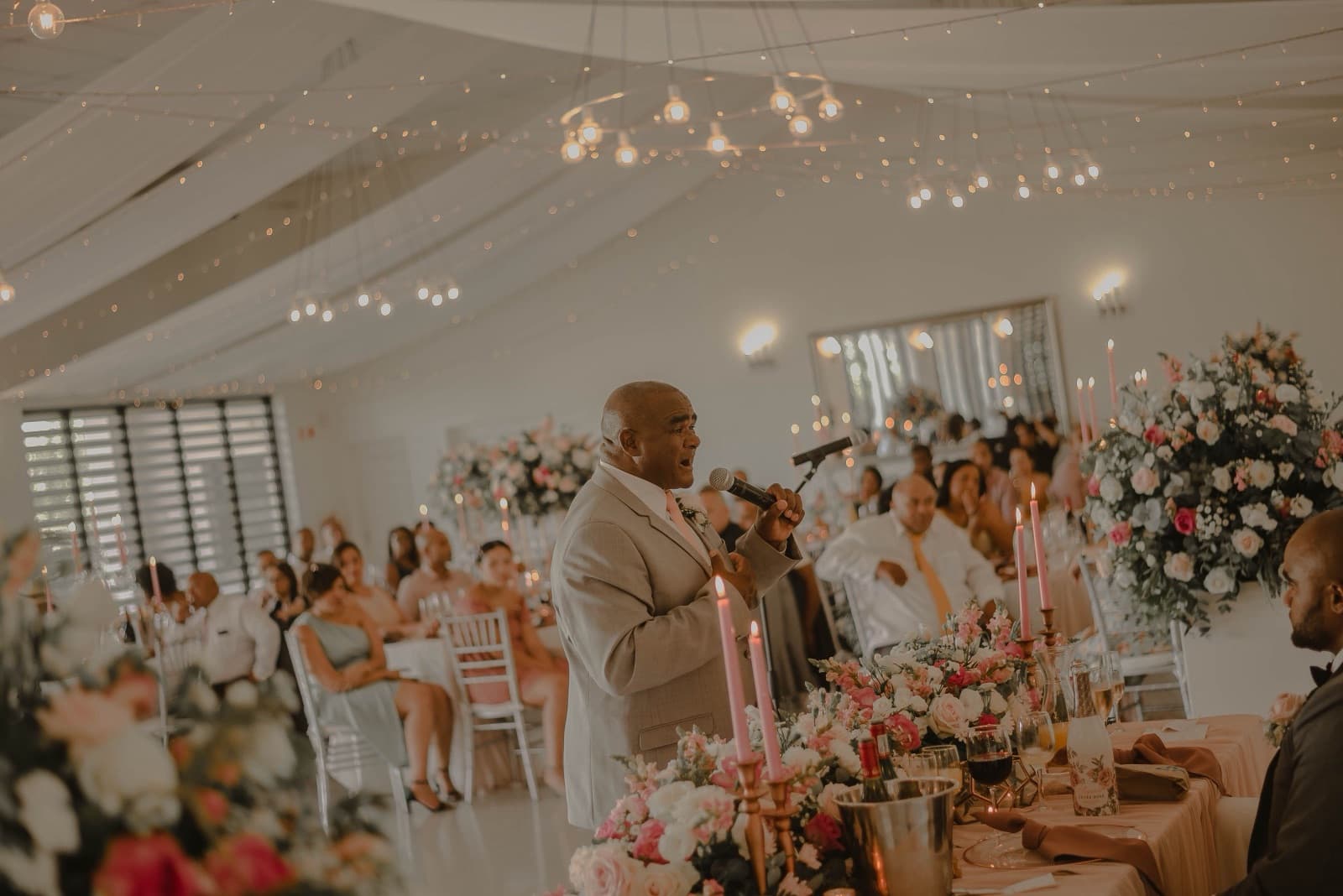
A wedding speech is a strange piece of public speaking. The audience is entirely on your side, wants you to do well, and has had a drink. It is the easiest room you will ever have. And yet most weddings contain at least one speech where the room quietly begins studying the tablecloth.
They fail in three ways, and none of them is a lack of talent.
One: it is too long
Five minutes is the target. Seven is the ceiling. Beyond that, attention goes and it does not come back — and a genuinely good speech that runs fifteen minutes is remembered as the long one.
Five minutes is roughly six hundred and fifty words. That is much less than it sounds, which is the point: it forces you to keep only the good material. Time yourself out loud, standing up. Reading in your head is about thirty per cent faster than speaking to a room, so the version that fits on paper does not fit in reality.
Two: it is a list of anecdotes
The commonest structure is "here are some funny things that happened", and it does not build. Every story lands the same, and by the fourth one the room has stopped tracking.
A structure that works, whoever is speaking:
- Who you are and how you know them. One or two sentences. A third of the room has no idea who you are.
- One story. Not four. One, told properly, with enough detail that people can see it.
- What the story reveals about them. This is the hinge, and it is what turns an anecdote into a point.
- What that means now they are married. The story earns you the right to be sincere for thirty seconds.
- The toast. Short, clear, glass up.
The reason this works is that it goes somewhere. The audience can feel a shape, and a room that can feel the shape stays with you.
Three: the material is for the wrong room
The test is not "is this funny". It is "is this funny to a ninety-year-old and a nine-year-old at the same time".
Cut anything involving an ex-partner. Cut the stag or hen weekend in any real detail. Cut anything that requires the audience to have been there, and anything whose punchline is that someone was very drunk. These get big laughs from the six people who were present and silence from everyone else, and silence is contagious.
The reliable currency is warmth with a sharp edge — teasing that is obviously affectionate. If you are not certain a line is on the right side, read it to someone who is not in your friendship group. Their face will tell you before they answer.
Who speaks, and in what order
The traditional order — father of the bride, groom, best man — is a convention, not a rule, and plenty of weddings ignore it entirely. Both partners speaking is now completely normal. So is a joint speech, a maid of honour, or a parent from each side.
What matters more than the order is that somebody is coordinating: that each speaker knows their slot and length, that the same three stories are not told twice, and that someone with a microphone knows when to hand it over. Left to itself, this is exactly the part of the day that expands.
If you want a starting point for structure by speaker, our speech templates and examples cover the common roles, and the best man and father of the bride ones are the most requested.
Practical things that make a real difference
- Have notes. Cards, not a phone — a phone looks like you are checking messages, and the screen locks. Nobody has ever thought less of a speaker for holding a card.
- Do not drink much beforehand. The speech you give after three glasses is not the one you wrote, and you will not remember which version happened.
- Slow down. Nerves speed everyone up. Deliberately slower than feels natural will sound normal from the floor.
- Look up at the ends of sentences. That is where the laughs are, and you need to be looking at people to get them.
- Test the microphone in the room, if there is one. Rooms with hard surfaces and ninety people in them swallow an unamplified voice.
If you are nervous
Write the first line and the last line out in full and learn them. Beginnings and endings are where nerves do their damage; the middle looks after itself once you are moving.
And remember what this audience is. They are not judging the speech. They are pleased to be there, fond of the person speaking, and entirely willing to laugh. You are not auditioning. You are one of the few people who gets to say out loud what everyone in the room already thinks, and almost nobody regrets doing that badly. They only regret not doing it.